
HOW PIONEER WORKS
Connected ideas. Explicit boundaries.
Pioneer puts model reasoning alongside deterministic work. The important connection is not a promise that every application is one product: it is a visible chain from intent to evidence.
FAMILY MAP / CLI FOUNDATION & CURRENT RUNTIMES
Visual-workflow lane
Pioneer Flow
↓
Canvas + saved Flow definitions
↓
Transforms · models · scripts · approvals
↓
Run outputs and durable execution evidence
Repository-engineering lane
Pioneer Chat / Pioneer Command
↓
Pioneer Engineer CLI
↓
Explicit model selection + approved source/tools/checks
↓
Retained outcomes and independent verification
Pioneer CLI is the family’s engineering foundation and originated in Flow. The improved standalone CLI powers Chat and Command now. Those improvements are being folded back into Flow; the shared runtime integration is still in progress, so the diagram separates the current runtime lanes.
No general-purpose Flow↔Command orchestration is implied. External model processing requires explicit configuration and consent; local-first does not mean every possible workflow is offline.
WORKFLOW 01 / OPERATIONAL INCIDENT BRIEFING
Turn a bounded dataset into a reviewable briefing.
The existing recorded example reads a synthetic incident snapshot, normalizes and scores incidents, ranks operational priority, builds an evidence packet, creates a briefing record and retains the result. Approval before native code is demonstrated separately.
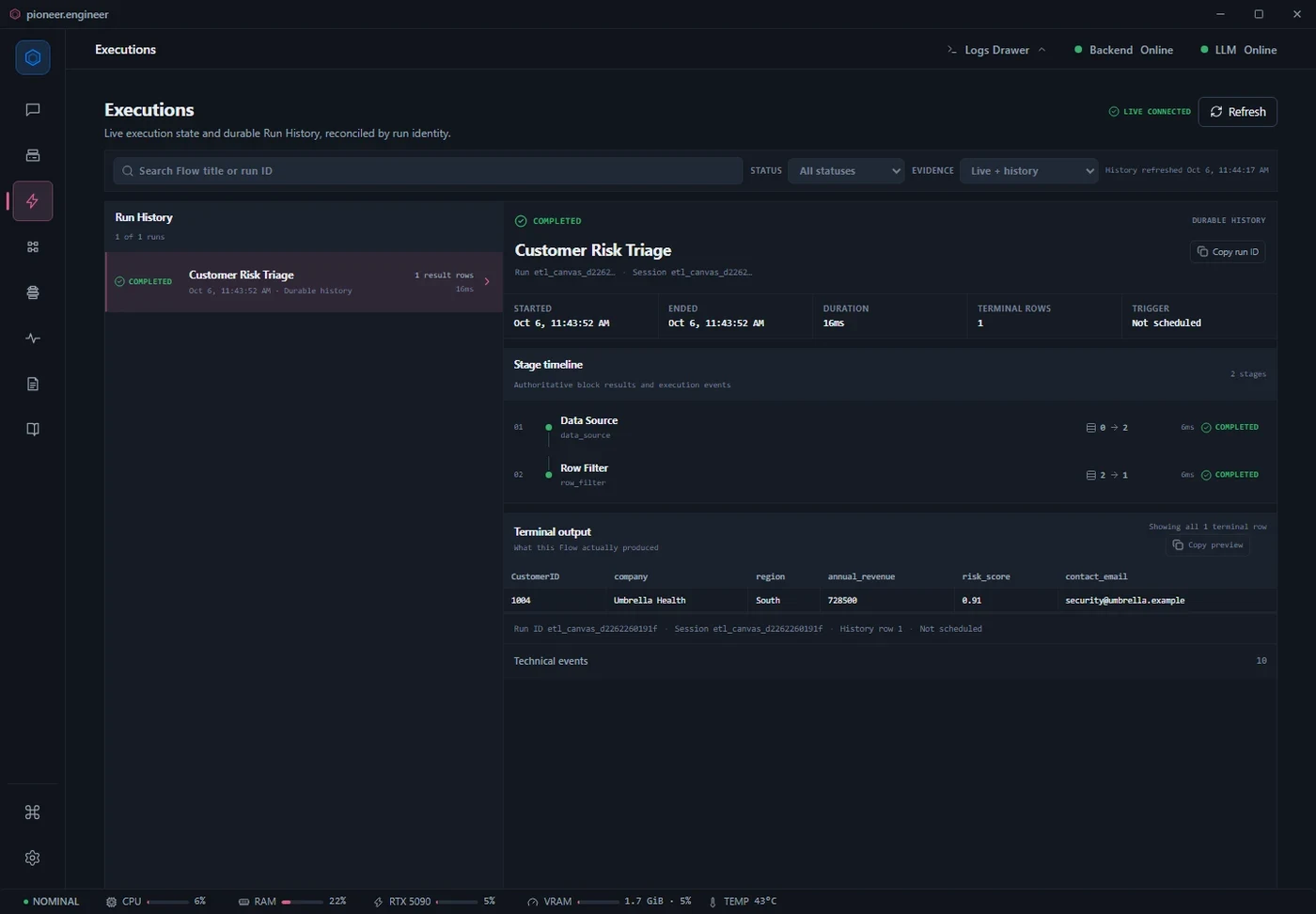
Existing hosted recordings remain on pioneer.engineer. They demonstrate bounded scenarios, not universal autonomy or a new commercial qualification.
WORKFLOW 02 / BOUNDED ENGINEERING
A small change. A visible acceptance trail.
Prepare + authorize
Choose a repository and a model. Define the objective, readable/editable source and approved checks. Review the frozen task before allowing execution.
Execute + inspect
Follow tool activity, changes and failures. Use supported pause/resume or cancellation without treating uncertainty as success.
Verify + review
Inspect protected verification and retained evidence separately from the model’s own claim. Human acceptance remains an explicit decision.
Coordinate deliberately
Command can arrange approved sequential work and one-time scheduling. No parallel-agent squad or unlimited automatic retry is implied.
Useful intelligence needs clear operating limits.
Flow includes token/time budget governance and supported resource observations. Command specialist selection exposes evidence and qualification gaps. Missing telemetry remains unknown; a saved configuration is not proof that execution is ready.